CloudZen Expertise

Enterprise PLM Architecture for Teamcenter Enterprise and TOGAF-Led Transformation

From overlapping systems to a clear enterprise blueprint, CloudZen turns PLM complexity into business clarity — covering enterprise PLM architecture, TOGAF enterprise architecture, and Teamcenter enterprise design.

PLM transformation is not merely a technology replacement initiative; it must be driven by business objectives. Many organizations overlook the critical role of business architecture when embarking on transformation journeys.

Business Challenge for Enterprise Architecture

Many organizations struggle to realize expected value because PLM initiatives are approached as technology replacement programs rather than business-driven transformations.

Misalignment between business goals and systems

Transformation programs often begin without a clearly defined business architecture, making it difficult to align platforms with strategic objectives.

Overlapping application capabilities

Enterprise landscapes frequently contain multiple systems with redundant functionality, increasing complexity and confusion across teams.

Fragmented product and process data

Information is spread across disconnected tools, making end-to-end visibility, governance, and traceability difficult to maintain.

Inefficient end-to-end processes

Disconnected operating models and unclear system roles create friction across engineering, manufacturing, and downstream business processes.

Higher operating cost and complexity

Redundant applications and duplicated data structures increase licensing, maintenance, and transformation costs over time.

Limited clarity for future-state decisions

Without a structured enterprise blueprint, organizations struggle to define the right roadmap, sequencing, and architectural guardrails.
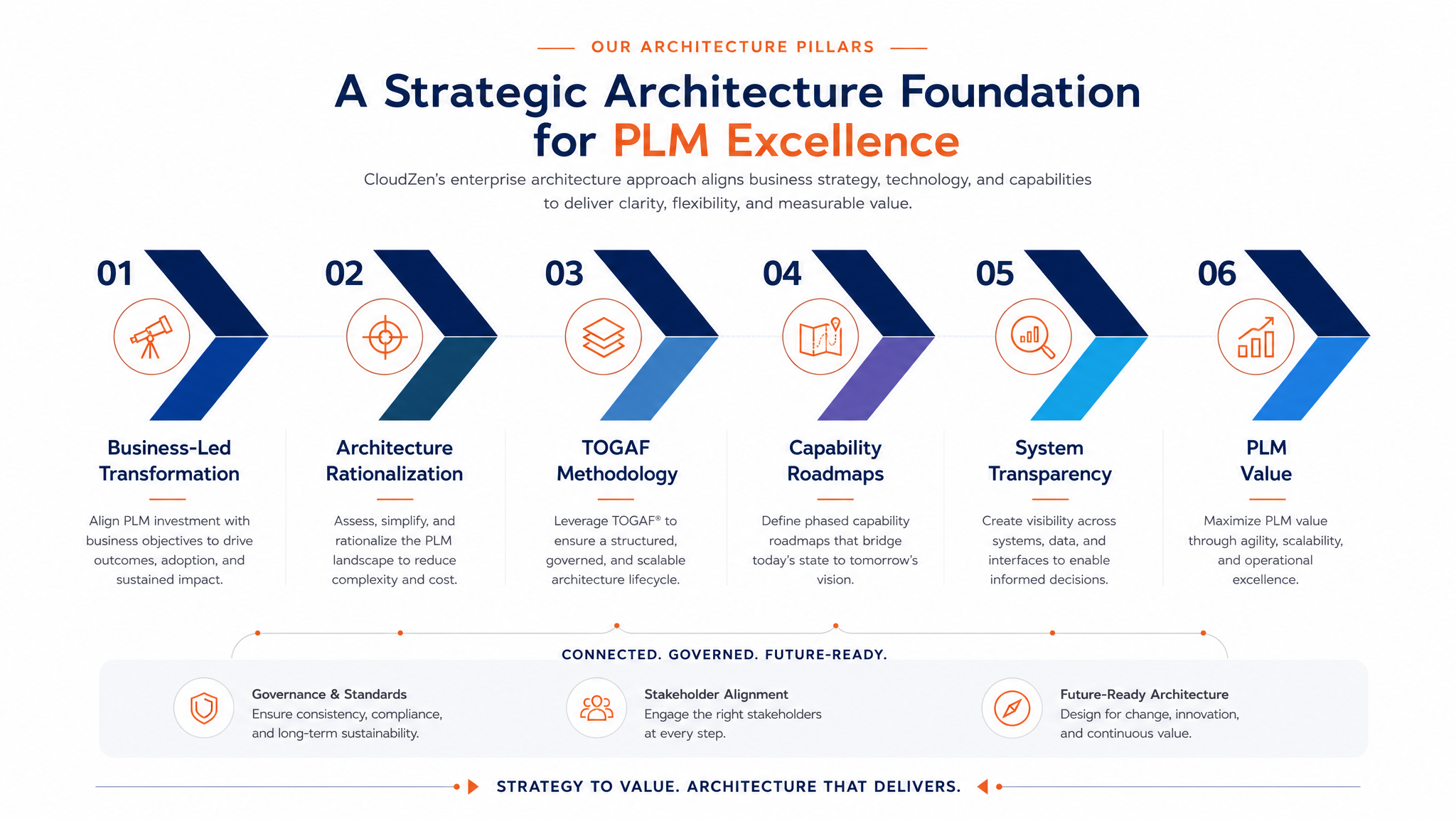
PLM Enterprise Architecture strategic pillars visualization

Our Enterprise PLM Architecture Approach

CloudZen applies a comprehensive Enterprise Architecture approach driven by TOGAF methodology and viewed through three connected architecture lenses.

Lens 1

Strategic Architecture — TOGAF Enterprise Architecture

Align transformation direction to business goals, operating priorities, and enterprise guardrails using a TOGAF enterprise architecture framework.

Lens 2

Conceptual Architecture — PLM Architecture Design

Define target-state business capabilities, application roles, information flows, and architectural plateaus that shape the roadmap.

Lens 3

Solution Architecture — Teamcenter Enterprise Design

Translate the target-state view into detailed solution design, implementation direction, and deployable architecture structures.

Method

TOGAF Business Architecture Rationalization

Use TOGAF business architecture modelling to eliminate redundancy, improve data consistency, and maximize the business value of PLM investments.

What the Offering Includes

The engagement combines targeted consulting services with the structured application of CloudZen’s architecture framework.
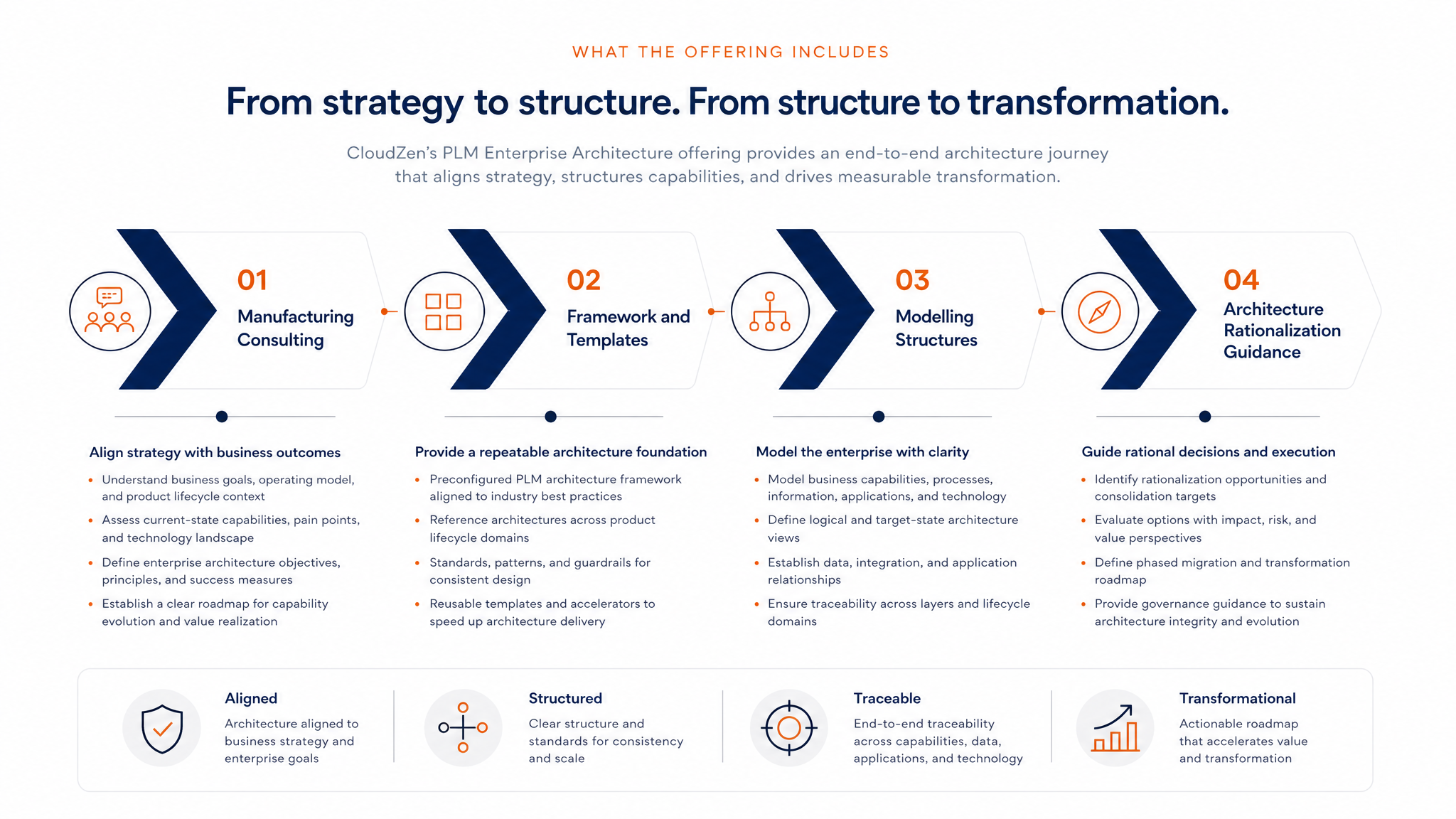
What the Offering Includes flow for PLM Enterprise Architecture

Manufacturing Consulting

  • Facilitate workshops to position PLM, ERP, and MES applications across the enterprise landscape.
  • Identify design options for end-to-end processes and operating model alignment.
  • Support architecture decisions with practical manufacturing and PLM consulting insight.
  • Apply Teamcenter enterprise architecture PLM architecture best practices to define application roles, integration points, and governance standards across the enterprise landscape.

Framework & Templates

  • Use Enterprise Architecture Management structures to map process, product data, system, and infrastructure architectures.
  • Create reusable templates that improve consistency, modelling speed, and governance visibility.
  • Establish a structured base for architecture transparency and future planning.

Modelling Structures

  • Provide logically arranged model structures and end-to-end application templates.
  • Improve traceability and reuse across architectural views and transformation workstreams.
  • Support clearer decision-making through connected enterprise models.

Architecture Rationalization Guidance

  • Identify redundant tools, duplicated capabilities, and unclear ownership boundaries.
  • Improve architectural clarity before major transformation or consolidation decisions.
  • Help define a roadmap that balances business priorities and implementation feasibility.

Business Outcomes

The objective is to reduce complexity, improve transparency, and create an enterprise architecture foundation that accelerates transformation value.
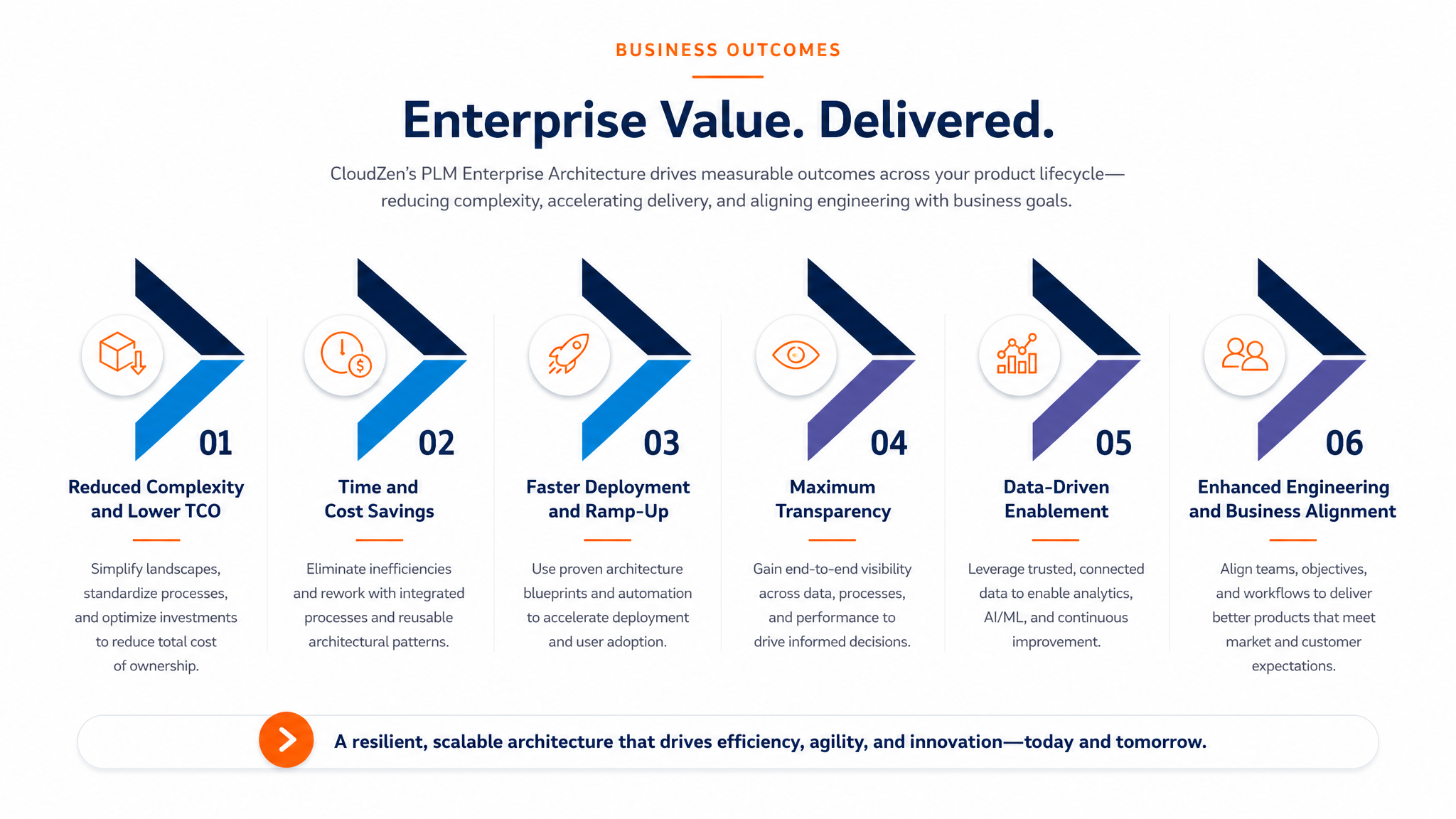
Business Outcomes diagram for PLM Enterprise Architecture

Reduced Complexity and Lower TCO

Identify and eliminate redundant applications to reduce licensing, support, and maintenance costs across the landscape.

Time and Cost Savings

Centralized modelling helps create information once and reuse it across architectural views, decisions, and downstream implementation activities.

Faster Deployment and Ramp-Up

A structured architecture baseline helps teams move more quickly from decision-making into transformation planning and execution.

Maximum Transparency

Gain better visibility into information flows, application roles, and dependencies to support more confident planning.

Data-Driven Enablement

Improve the consistency and accessibility of enterprise information required for future-state decision-making and platform optimization.

Enhanced Engineering and Business Alignment

Create stronger alignment between architecture decisions, engineering operations, and broader enterprise transformation goals.

How the Delivery Works

The delivery model progresses from strategic alignment into conceptual blueprinting and then into solution-level architecture and implementation guidance.
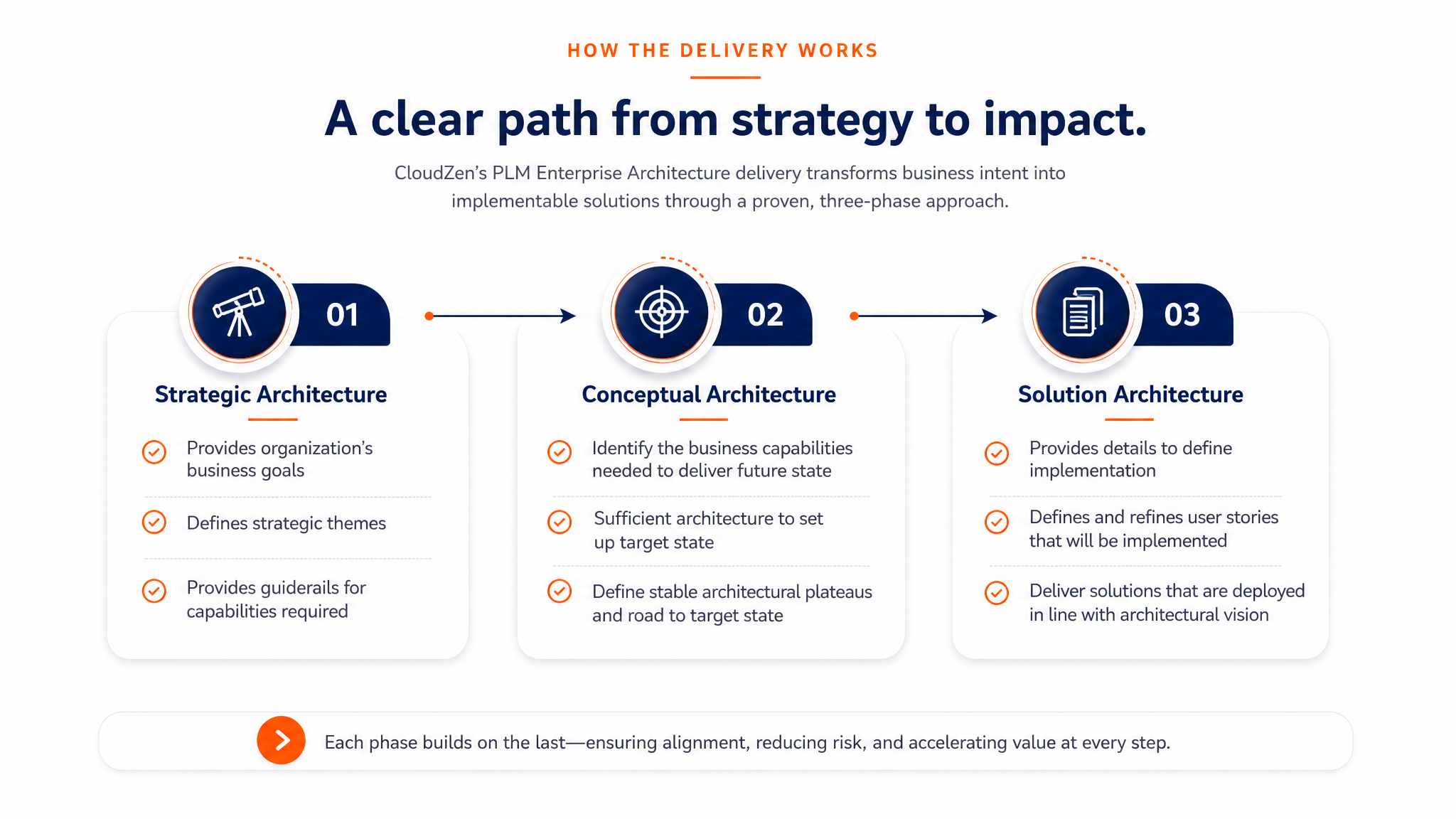
How the Delivery Works visual for PLM Enterprise Architecture

What Makes Our Enterprise PLM Architecture Offer Different

Business-Led Enterprise Architecture Framing

The engagement begins with business objectives and architecture clarity rather than reducing the effort to a technology-only exercise.

Structured TOGAF Enterprise Architecture Methodology

CloudZen applies a recognized enterprise architecture approach to connect strategy, capabilities, and solution execution in one model.

Senior Enterprise PLM Architecture Consulting

Experienced consultants guide the work from assessment and modelling through roadmap and implementation definition.

Specialist Teamcenter Enterprise Perspective

The offer combines architecture expertise with practical understanding of discrete manufacturing and PLM transformation realities.

Practical Rationalization Focus

The approach is designed to reduce redundancy, clarify system roles, and improve enterprise-wide transparency in a usable way.

Clear Path to Executable Transformation Plans

Clients receive a roadmap that links strategic architecture thinking to concrete architectural structures and delivery actions.

Contact us to learn more about our Enterprise architecture offering

Turn overlapping systems, fragmented data, and unclear architecture decisions into a business-led enterprise blueprint for PLM transformation.

Frequently Asked Questions

What is enterprise PLM architecture?
Enterprise PLM architecture defines the target-state design for product lifecycle management platforms across an organization, covering application roles, data flows, integration points, governance structures, and the roadmap to achieve a rationalized, business-aligned PLM landscape.
What is TOGAF enterprise architecture?
TOGAF enterprise architecture is a framework and methodology for designing, planning, implementing, and governing enterprise IT architectures. It uses the Architecture Development Method (ADM) to connect business strategy, capabilities, and technology solutions in a structured, repeatable way.
What is TOGAF business architecture?
TOGAF business architecture defines the business strategy, governance, organization, and key business processes that drive the design of the enterprise architecture. It ensures that technology and system decisions are grounded in business objectives and operating model requirements.
How does Teamcenter enterprise architecture work?
Teamcenter enterprise architecture defines how Siemens Teamcenter is positioned within the broader enterprise landscape, covering its role relative to ERP, MES, and other connected systems, its data ownership boundaries, integration patterns, and the roadmap for consolidation or modernization.
What is the difference between PLM architecture and enterprise architecture?
PLM architecture focuses specifically on the design and governance of product lifecycle management platforms such as Teamcenter. Enterprise architecture takes a broader view, covering all business capabilities, applications, data flows, and technology across the organization. CloudZen applies enterprise architecture thinking to PLM transformation to ensure PLM decisions align with the full enterprise operating model.

Ready to Transform Your Business?

Let's discuss how CloudZen can accelerate your digital journey. Free initial consultation — no strings attached.