Why API-First is Reshaping PLM
For decades, Product Lifecycle Management (PLM) systems have served as the backbone of engineering organizations. They manage product structures, CAD files, Bills of Materials (BOMs), change processes, and engineering documentation. However, many PLM implementations still rely on tightly coupled, point-to-point integrations that were designed for a different era.
As manufacturers embrace cloud platforms, digital thread initiatives, AI-driven engineering, and connected factories, traditional integration models have become a significant barrier to innovation.
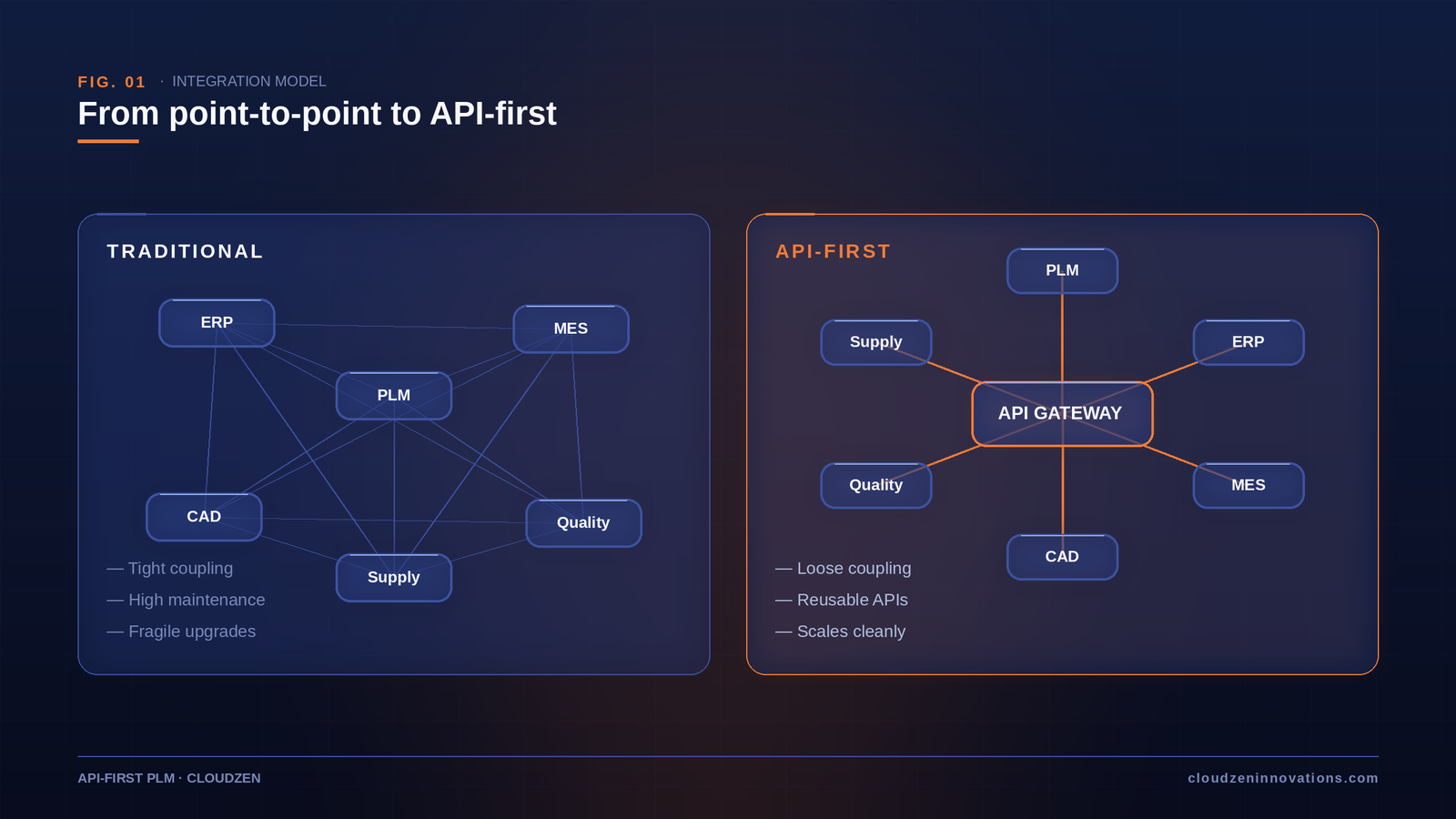
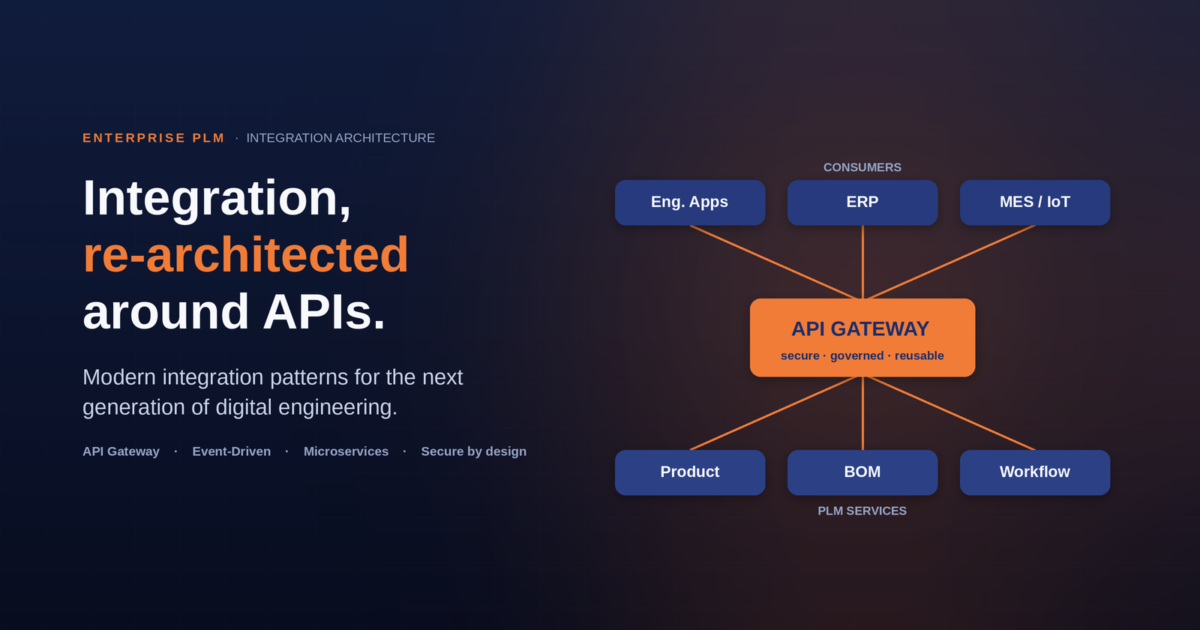
The solution is an API-First PLM architecture—an approach where every business capability is exposed through secure, reusable, and well-governed APIs. Instead of treating integration as an afterthought, APIs become the foundation for interoperability, scalability, and future modernization.
The Challenges of Traditional PLM Integrations
Many enterprise PLM environments have evolved over years of custom development. Common integration patterns include:
- Direct database queries
- Batch file transfers
- Custom ITK-based integrations
- Shared network folders
- Synchronous point-to-point connections
- Hardcoded ERP interfaces
While these methods may meet immediate business needs, they introduce long-term challenges:
- High maintenance costs
- Tight coupling between systems
- Complex upgrade paths
- Limited scalability
- Data inconsistency
- Slow integration delivery
- Difficult debugging and monitoring
As the number of connected enterprise applications grows, these integrations become increasingly fragile and expensive to maintain.
What Does API-First Mean?
API-First is an architectural philosophy where APIs are designed before implementation.
Instead of asking:
“How do we connect this application?”
The question becomes:
“What business capability should this API expose?”
Examples include:
- Create Engineering Change Request
- Retrieve Product Structure
- Search Engineering Documents
- Manage BOM Revisions
- Approve Workflow Tasks
- Publish Product Metadata
These APIs become reusable building blocks for multiple applications instead of one-off integrations.
Core Principles of API-First PLM
1. Business Capability over Technical Interface
Design APIs around engineering business processes rather than database tables.
Instead of:
GET /ItemRevisionDesign:
GET /products/{id}/latest-revisionThe API should reflect business intent, making it easier for consuming applications to understand and use.
2. Loose Coupling
Applications should communicate through APIs rather than directly accessing PLM databases or proprietary components.
Instead of:
ERP → DatabaseUse:
ERP → API Gateway → PLM ServicesThis minimizes dependencies and allows systems to evolve independently.
3. Stateless Services
Each API request should contain all the information needed to process it. Stateless APIs are easier to scale, cache, and secure, making them ideal for cloud-native deployments.
4. Versioning Strategy
Engineering integrations often have long lifecycles. Introducing API versioning prevents breaking changes.
Example:
/api/v1/products
/api/v2/products
Versioning enables gradual adoption while maintaining backward compatibility.
5. Security by Design
Engineering data represents valuable intellectual property. Modern APIs should support:
- OAuth 2.0
- OpenID Connect
- JWT-based authentication
- Role-based access control
- API rate limiting
- Audit logging
Security should be embedded into the API architecture rather than added later.
Modern Integration Patterns
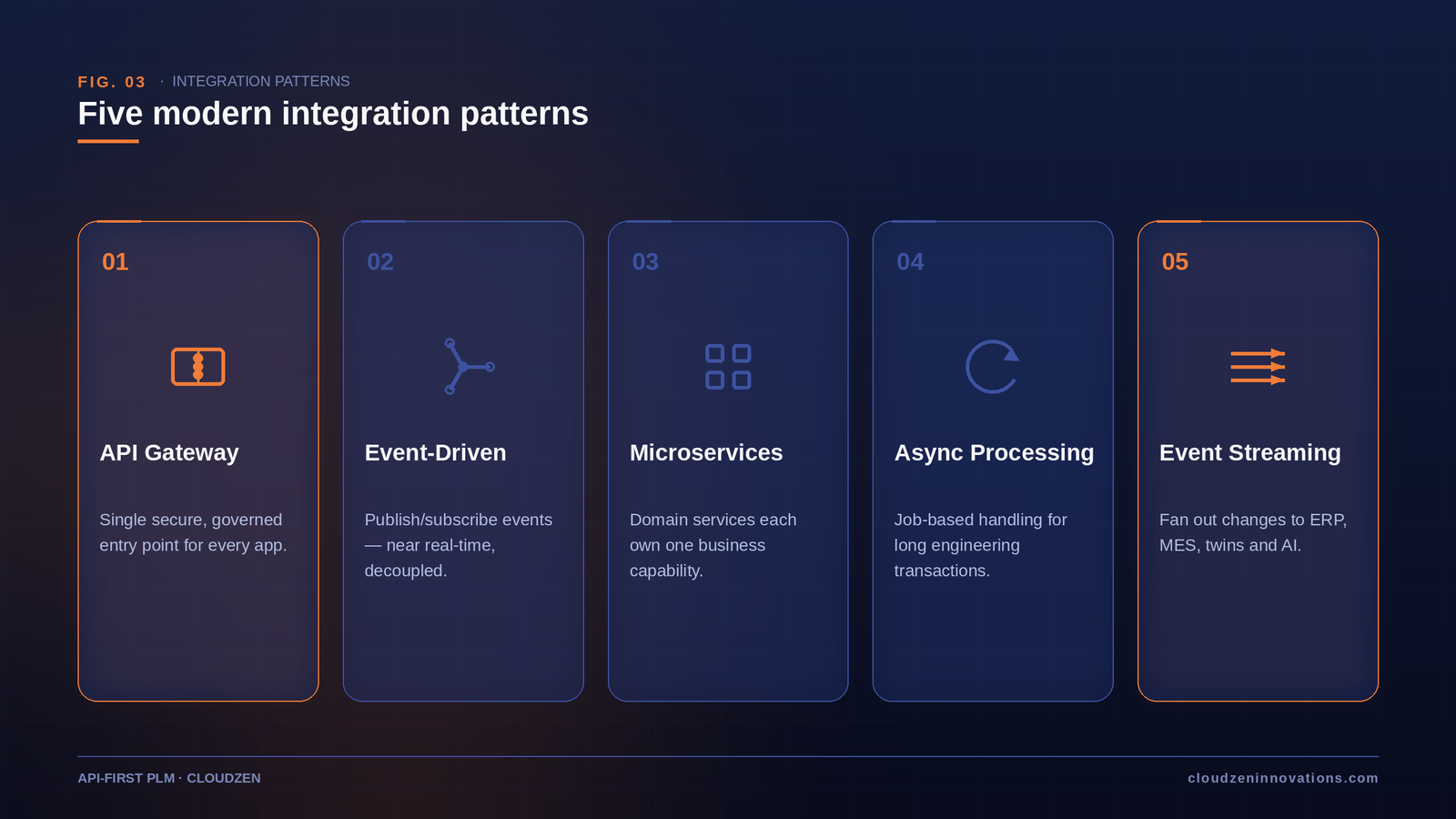
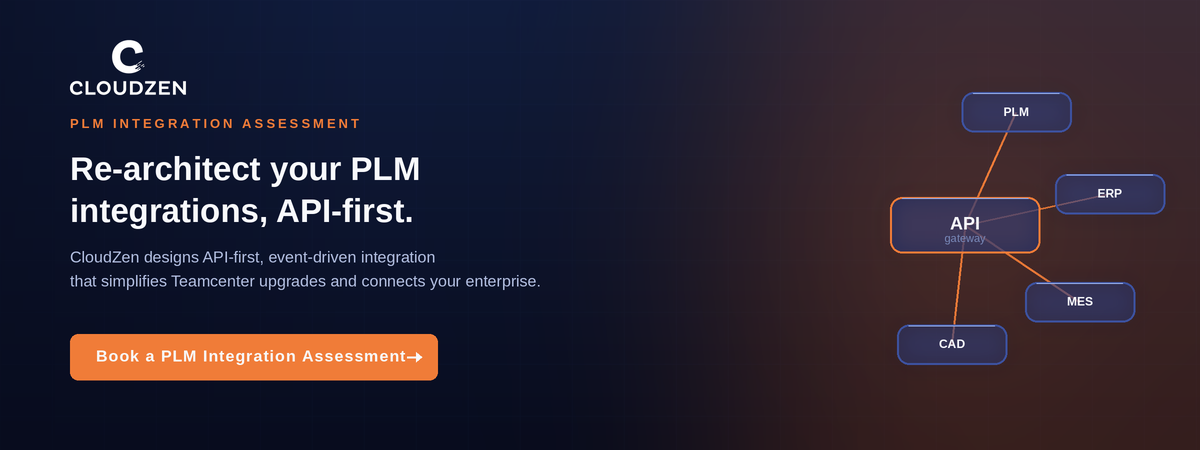
Pattern 1: API Gateway
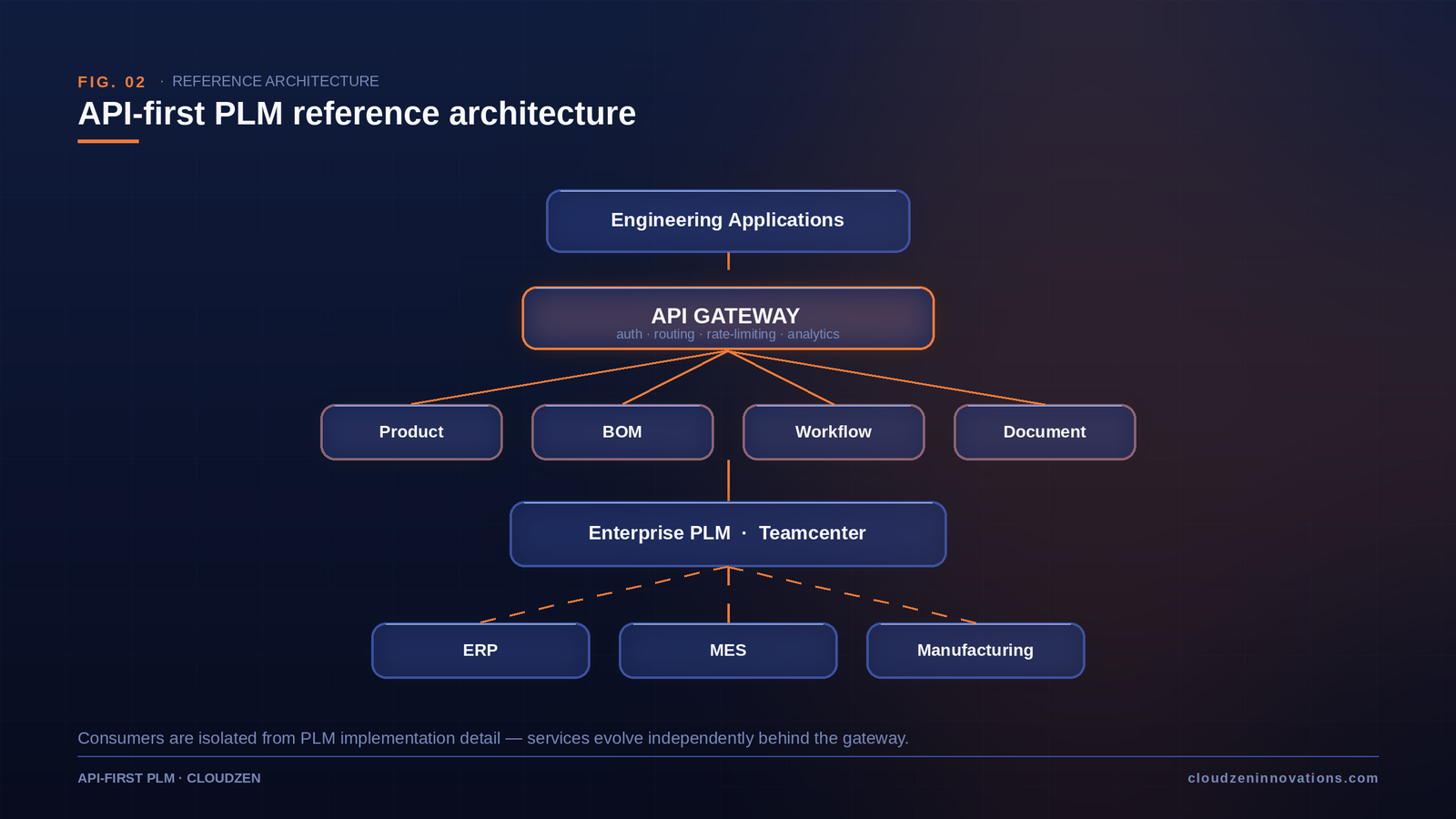
Instead of exposing PLM services directly, introduce an API Gateway.
Benefits include:
- Authentication
- Authorization
- Traffic management
- Rate limiting
- Monitoring
- API analytics
- Centralized governance
The gateway becomes the single entry point for all engineering applications.
Pattern 2: Event-Driven Architecture
Traditional integrations rely heavily on synchronous API calls. A modern alternative is event-driven integration.
Example events:
- Item Created
- Revision Released
- BOM Updated
- Workflow Completed
- Change Notice Approved
These events are published to an event broker, allowing downstream systems to subscribe and react without creating direct dependencies.
Benefits:
- Near real-time synchronization
- Reduced system coupling
- Better scalability
- Improved resilience
Pattern 3: Microservices
Instead of one large integration service, divide functionality into domain-specific services.
Examples:
- Product Service
- BOM Service
- Workflow Service
- Document Service
- Change Management Service
Each service owns its business capability, improving maintainability and scalability.
Pattern 4: Asynchronous Processing
Large engineering transactions—such as BOM imports, CAD synchronization, or mass updates—can take several minutes. Avoid long-running synchronous requests.
Instead:
- Submit request
- Receive Job ID
- Process asynchronously
- Notify completion
- Retrieve results
This approach improves user experience and system stability.
Pattern 5: Event Streaming
Engineering organizations generate thousands of business events daily. Platforms such as Apache Kafka or similar event-streaming technologies can distribute these events across multiple consumers, including ERP, MES, analytics platforms, digital twins, and AI applications.
Rather than polling for updates, downstream systems receive changes as they occur.
Best Practices
Organizations modernizing PLM should consider the following:
- Avoid direct database integrations.
- Design APIs around business capabilities.
- Standardize RESTful conventions and error handling.
- Adopt OpenAPI specifications for documentation.
- Implement centralized API governance.
- Use asynchronous messaging for long-running operations.
- Maintain backward compatibility through versioning.
- Monitor API performance and usage.
- Secure APIs using industry-standard authentication and authorization mechanisms.
- Automate API testing and deployment within CI/CD pipelines.
Common Anti-Patterns
Many integration challenges stem from avoidable architectural decisions. Examples include:
- Direct SQL access to PLM databases
- Business logic embedded in integration scripts
- Duplicate APIs performing similar functions
- Hardcoded endpoint URLs
- Lack of API documentation
- Synchronous integrations for large engineering transactions
- Ignoring API lifecycle management
- No monitoring or observability
Identifying and eliminating these anti-patterns reduces operational risk and simplifies future modernization efforts.
Business Benefits
An API-First approach delivers measurable value beyond technical improvements. Organizations can expect:
- Faster integration of new engineering applications
- Reduced maintenance effort
- Simplified Teamcenter upgrades
- Improved interoperability across enterprise systems
- Enhanced support for cloud and hybrid deployments
- Better scalability for global engineering teams
- Stronger security and governance
- Faster adoption of AI, analytics, and digital thread initiatives
Most importantly, API-First architectures enable organizations to innovate without continually rewriting integrations.
Conclusion
PLM is no longer an isolated engineering repository. It is the central source of product information that powers ERP , MES, manufacturing execution, supply chain collaboration, simulation, analytics, and AI-driven decision-making.
An API-First integration strategy transforms PLM into an open, scalable platform capable of supporting modern digital engineering ecosystems. By replacing brittle point-to-point integrations with well-designed APIs and event-driven communication, manufacturers can reduce technical debt, accelerate innovation, and build a foundation for the next generation of connected engineering.
For organizations planning a PLM modernization initiative, API-First is not simply a technology choice—it is a strategic architectural investment that enables greater agility, resilience, and long-term business value.